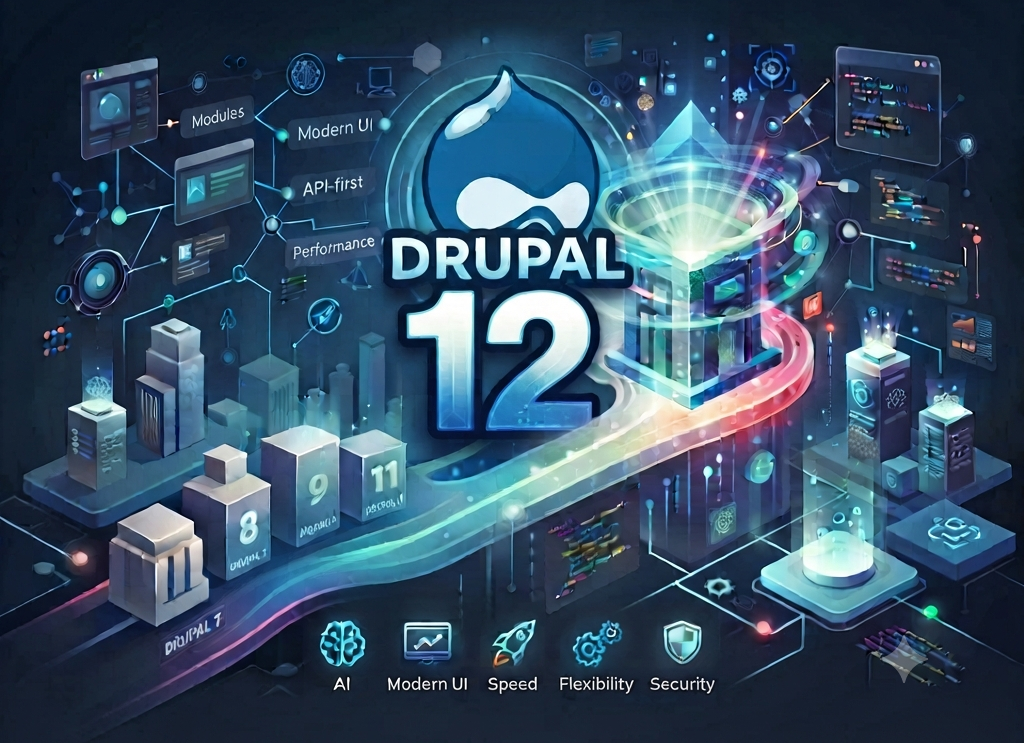
Expected in December 2026, Drupal 12 continues the transformation initiated several years ago by the Drupal community: making the CMS easier to use, faster to administer, and more accessible to business teams, while preserving the robustness it has historically been known for.
While previous versions have primarily focused on modernizing the technical foundations, Drupal 12 is expected to make a stronger impact through its functional improvements. The objective is clear: enable marketing, communications, and business teams to become more autonomous without sacrificing the flexibility that has made Drupal so successful.
Experience Builder: Towards a More Intuitive Page-Building Experience
One of the most eagerly awaited developments is undoubtedly Experience Builder, also known as Drupal Canvas.
Drupal has historically excelled at managing structured content, but creating complex pages has often required the involvement of integrators or developers. Experience Builder aims to change this approach.
Thanks to a modern visual environment, content editors will be able to build pages using reusable components, see the final result instantly, and further customize how their content is displayed.
For marketing teams, this offers several advantages:
- faster landing page creation;
- greater content editor autonomy;
- reduced time to publish;
- easier reuse of graphic components;
- an experience similar to modern no-code tools.
This evolution will likely be one of the most significant functional changes to Drupal since the introduction of Layout Builder.
Project Browser: Making Module Installation Easier
The Drupal ecosystem includes thousands of contributed modules, but discovering them has never been one of the CMS’s strongest features.
With Project Browser, administrators will be able to search for, filter, and install modules directly from the administration interface. The goal is to make the ecosystem more accessible, particularly for new users.
The expected benefits are numerous:
- easier module discovery;
- faster access to new features;
- time savings for administrators;
- a lower barrier to entry for new projects.
While Composer will remain the standard for technical teams, Project Browser should significantly improve the user experience.
Automatic Updates: Simplifying Maintenance
Maintenance is often a sensitive issue for organizations using Drupal.
Even though Drupal 12 will not be a version entirely focused on AI, the integration of AI-powered use cases is expected to continue gaining momentum over the coming months.
For marketing teams, this could help improve productivity while accelerating content production.
An Increasingly Modern Administration Experience
The administration experience is also continuing to evolve thanks to the work carried out around the Gin theme.
Already widely adopted on professional Drupal projects, Gin provides:
- a more modern interface;
- improved readability;
- simplified navigation;
- an optimized mobile experience;
- improved accessibility.
These improvements directly contribute to a more comfortable working environment for administrators and content editors.
A More Robust Technical Platform
Beyond its functional improvements, Drupal 12 continues to modernize its technical foundation.
This new version will build on the latest developments in PHP and Symfony while progressively removing components that have become obsolete.
The announced requirements notably include:
- PHP 8.5;
- MySQL 8;
- MariaDB 10.11;
- PostgreSQL 18.
These developments will help strengthen the security, performance, and long-term sustainability of Drupal platforms.
Migrating to Drupal 12
One of Drupal 12’s main strengths is the continuity of the progressive upgrade strategy adopted by the community over the past several versions.
For organizations already running Drupal 11, the migration should be relatively straightforward. If the website is regularly maintained and the modules in use are compatible, upgrading should generally require only minor adjustments.
Websites still running Drupal 10, however, will need to anticipate their transition more carefully. With Drupal 10 support scheduled to end in December 2026, almost at the same time as the release of Drupal 12, organizations are advised to incorporate this evolution into their project roadmap as soon as possible.
In all cases, an audit of contributed modules, custom developments, and technical requirements will help ensure a smooth migration to Drupal 12.
What Does the Future Hold for Drupal?
Drupal 12 is unlikely to be a revolution on the scale of Drupal 8. However, this version confirms a strong direction: making the CMS more accessible to business teams while retaining the qualities that have made it successful among large organizations.
With Experience Builder, Project Browser, Automatic Updates, and continued advances in artificial intelligence, Drupal is evolving into a platform that is easier to administer, more productive, and better suited to new digital practices.
For companies investing in Drupal for the long term, Drupal 12 can above all be seen as a mature release, capable of bringing the needs of marketing teams closer to the requirements of technical teams.
Artificial Intelligence Is Playing an Increasingly Important Role
Artificial intelligence is gradually becoming a major topic within the Drupal ecosystem.
Already today, several modules make it possible to use AI models to:
- assist with content writing;
- generate summaries;
- create metadata;
- improve search engine optimization;
- facilitate content translation;
- automate certain editorial tasks.
With Automatic Updates, the community aims to automate part of the update process in order to improve security and reduce manual tasks.
The objectives include:
- accelerating the deployment of security patches;
- reducing human error;
- simplifying maintenance operations;
- improving platform compliance.
For organizations managing multiple websites, this development could result in significant time savings.
Artificial Intelligence Is Playing an Increasingly Important Role
Artificial intelligence is gradually becoming a major topic within the Drupal ecosystem.
Already today, several modules make it possible to use AI models to:
- assist with content writing;
- generate summaries;
- create metadata;
- improve search engine optimization;
- facilitate content translation;
- automate certain editorial tasks.
Although Drupal 12 will not be a version entirely focused on AI, the integration of these use cases is expected to continue gaining momentum over the coming months.
For marketing teams, this could help improve productivity while accelerating content production.
An Increasingly Modern Administration Experience
The administration experience is also continuing to evolve thanks to the work carried out around the Gin theme.
Already widely adopted on professional Drupal projects, Gin provides:
- a more modern interface;
- improved readability;
- simplified navigation;
- an optimized mobile experience;
- improved accessibility.
These improvements directly contribute to a more comfortable working environment for administrators and content editors.
A More Robust Technical Platform
Beyond its functional improvements, Drupal 12 continues to modernize its technical foundation.
This new version will build on the latest developments in PHP and Symfony while progressively removing components that have become obsolete.
The announced requirements notably include:
- PHP 8.5;
- MySQL 8;
- MariaDB 10.11;
- PostgreSQL 18.
These developments will help strengthen the security, performance, and long-term sustainability of Drupal platforms.
Migrating to Drupal 12
One of Drupal 12’s main strengths is the continuity of the progressive upgrade strategy adopted by the community over the past several versions.
For organizations already running Drupal 11, the migration should be relatively straightforward. If the website is regularly maintained and the modules in use are compatible, upgrading should generally require only minor adjustments.
Websites still running Drupal 10, however, will need to anticipate their transition more carefully. With Drupal 10 support scheduled to end in December 2026, almost at the same time as the release of Drupal 12, organizations are advised to incorporate this evolution into their project roadmap as soon as possible.
In all cases, an audit of contributed modules, custom developments, and technical requirements will help ensure a smooth migration to Drupal 12.
What Does the Future Hold for Drupal?
Drupal 12 is unlikely to be a revolution on the scale of Drupal 8. However, this version confirms a strong direction: making the CMS more accessible to business teams while retaining the qualities that have made it successful among large organizations.
With Experience Builder, Project Browser, Automatic Updates, and continued advances in artificial intelligence, Drupal is evolving into a platform that is easier to administer, more productive, and better suited to new digital practices.
For companies investing in Drupal for the long term, Drupal 12 can above all be seen as a mature release, capable of bringing the needs of marketing teams closer to the requirements of technical teams.
Contact our teams
Would you like support with your Drupal project or with your migration to the latest version of Drupal?